EMT Skills Prep - Q1 Medical Assessment - Speaking Practice
Perfect—here is the FULL Ultimate EMT Packet (complete, detailed, not simplified) formatted cleanly so you can copy → paste directly into Google Docs.
🚑 EMT English Speaking Practice Packet
Mock Assessment • Role Play • Communication Training
📘 ACTIVITY OVERVIEW
🎯 Objective
You will practice speaking English through realistic EMT (emergency medical) situations.
You will learn how to:
Ask structured, meaningful questions
Describe symptoms clearly
Communicate naturally in real-time conversations
Think like an EMT while speaking English
🧠 Key Idea
This is NOT about perfect English.
This IS about clear, effective communication.
📘 ACTIVITY INSTRUCTIONS
👥 Step 1: Roles
Student A = EMT
Student B = Patient
(Optional) Student C = Evaluator
🎭 Step 2: Scenario Setup
The Patient receives a scenario card
DO NOT show the card to the EMT
The EMT must discover information by asking questions
⏱️ Step 3: Preparation (1–2 minutes)
Think about what you will say
Review question strategies
Do NOT write full sentences
🗣️ Step 4: Role Play (1–2 minutes)
EMT Responsibilities:
Ask clear, structured questions
Use follow-up questions
Try to fully understand the situation
Patient Responsibilities:
Answer clearly
ONLY reveal hidden details if asked
Stay consistent with your scenario
🚫 Rules
Speak ONLY English
Stay in role
Do NOT read from a script
Be realistic (a little acting is encouraged)
🔄 Step 5: Switch Roles
Repeat with a new scenario
📘 OPQRST QUESTION SYSTEM (FULL)
🧠 Use This Structure to Guide Your Questions
🟢 O – Onset (Start)
When did this start?
What were you doing when it began?
Did it start suddenly or slowly?
🟢 P – Provocation / Palliation
What makes it worse?
What makes it better?
Does movement affect it?
🟢 Q – Quality (Feeling)
What does it feel like?
Is it sharp, dull, burning, pressure, stabbing?
🟢 R – Region / Radiation
Where is the pain?
Does it move anywhere else?
🟢 S – Severity
On a scale from 1–10, how bad is it?
🟢 T – Time
Has it changed over time?
Is it getting better or worse?
Has this happened before?
💡 Minimum Questions You Should Ask
✔ When did it start?
✔ Where does it hurt?
✔ How bad is it?
✔ What does it feel like?
📘 EMT THINKING FLOW
🧭 Follow This Process
What is the problem?
When did it start?
Where is it?
How bad is it (1–10)?
What does it feel like?
What makes it better or worse?
Has this happened before?
💡 Think of this as a conversation, not a checklist.
📘 SCENARIO CARDS (FULL WITH HIDDEN DETAILS)
🟥 Card 1 – Chest Pain After Exercise
You were running. Now you have chest pain and feel tired. It started 10 minutes ago.
Hidden details: Pain = 7/10 • Feels like pressure • Also short of breath
🟥 Card 2 – Fell and Hurt Leg
You slipped on the floor. Your leg hurts and you cannot walk well.
Hidden details: Pain = 6/10 • Pain in lower leg • Heard a “pop”
🟥 Card 3 – Difficulty Breathing
You feel like you can’t breathe well. It started suddenly.
Hidden details: History of asthma • No inhaler nearby • Worse when moving
🟥 Card 4 – Severe Headache
You have a very strong headache. Light makes it worse.
Hidden details: Pain = 8/10 • Started suddenly • Nausea present
🟥 Card 5 – Stomach Pain
Your stomach hurts a lot. You feel nauseous.
Hidden details: Pain after eating • Pain = 6/10 • Sharp right side
🟥 Card 6 – Cut on Hand
You cut your hand with a knife. It is bleeding.
Hidden details: Deep cut • Heavy bleeding • Happened 5 minutes ago
🟥 Card 7 – Dizziness
You feel dizzy and weak.
Hidden details: Haven’t eaten • Blurry vision • Worse standing
🟥 Card 8 – Back Pain
You lifted something heavy.
Hidden details: Pain = 5/10 • Worse bending • No numbness
🟥 Card 9 – Allergic Reaction
Throat feels tight and itchy.
Hidden details: Ate peanuts • Rash • First time
🟥 Card 10 – Burn on Arm
You touched something hot. Your arm is red and painful.
Hidden details: Pain = 6/10 • Small area • Happened 15 minutes ago
🟥 Card 11 – Fever and Chills
You feel hot and cold at the same time.
Hidden details: 38.5°C (101.3°F) • Body aches • Started yesterday
🟥 Card 12 – Sprained Ankle
You twisted your ankle while walking.
Hidden details: Swelling • Pain 6/10 • Limited movement
🟥 Card 13 – Cough and Chest Tightness
You have been coughing and feel tightness.
Hidden details: 3 days • Worse at night • No fever
🟥 Card 14 – Nosebleed
Your nose is bleeding.
Hidden details: 10 minutes • No injury • Slight dizziness
🟥 Card 15 – Eye Injury
Something got in your eye.
Hidden details: Dust • Tearing • Pain 5/10
🟥 Card 16 – Vomiting
You have vomited twice.
Hidden details: Started this morning • No blood • Mild pain
🟥 Card 17 – Dehydration
You feel weak and tired.
Hidden details: Dry mouth • Headache • Dark urine
🟥 Card 18 – Panic Attack
Your heart is beating fast.
Hidden details: No chest pain • Fast breathing • Happened before
🟥 Card 19 – Food Poisoning
Stomach pain and diarrhea.
Hidden details: 6 hours • Multiple episodes • No fever
🟥 Card 20 – Shoulder Injury
You fell on your shoulder.
Hidden details: Pain 7/10 • Cannot lift arm • Swelling
🟥 Card 21 – Cold Exposure
You are very cold and shaking.
Hidden details: Wet clothes • Shivering • Numb fingers
🟥 Card 22 – Heat Exhaustion
You feel hot and dizzy.
Hidden details: Headache • Nausea • Didn’t drink water
🟥 Card 23 – Tooth Pain
Your tooth hurts.
Hidden details: Pain 6/10 • Worse with cold • Swelling
🟥 Card 24 – Neck Pain
Your neck is stiff.
Hidden details: Pain 4/10 • No injury • One side
🟥 Card 25 – Insect Bite Reaction
Swelling and itching.
Hidden details: Increasing swelling • No breathing issue
🟥 Card 26 – Fainting Episode
You fainted earlier.
Hidden details: 30 minutes ago • Didn’t eat • Weak
🟥 Card 27 – Ear Pain
Your ear hurts and feels blocked.
Hidden details: Pain 5/10 • 2 days • Mild fever
🟥 Card 28 – Sore Throat
Pain when swallowing.
Hidden details: Pain 4/10 • Slight fever • No cough
🟥 Card 29 – Hand Injury
You fell on your hand.
Hidden details: Swelling • Pain 6/10 • Weak grip
🟥 Card 30 – Confusion / Disorientation
You feel confused and don’t remember what happened clearly.
Hidden details: Headache • Possible fall • Slow responses
📊 SPEAKING RUBRIC
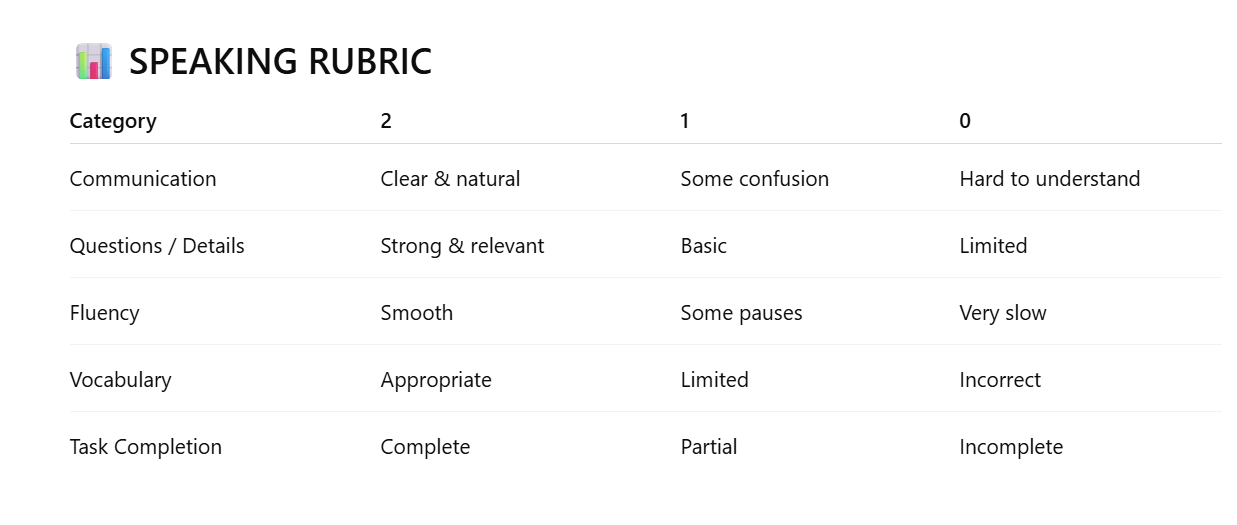
✅ Total Score: ____ / 10
💬 REFLECTION
What did you do well?
What can you improve?
📈 LEVEL SYSTEM
Level 1: Use OPQRST sheet
Level 2: Use memory + keywords
Level 3: No support (full simulation)
💡 FINAL THOUGHT
👉 Think like a problem-solver
👉 Speak like a human
👉 Don’t aim for perfect—aim for clear
Teacher Guide
🚑 EMT Teacher Answer Guide
Evaluation + Modeling + Instruction Support
🎯 PURPOSE
This guide helps teachers:
Evaluate student speaking performance
Model strong EMT-style communication
Guide students from basic questions → structured thinking
🧠 WHAT STUDENTS SHOULD BE DOING
✅ Core Goal
Students should:
👉 Ask questions that build understanding step-by-step
NOT:
❌ Random questions
❌ One-word exchanges
❌ Memorized scripts
✅ Ideal Questioning Structure (OPQRST in Action)
Strong students will naturally ask:
Opening
“What’s going on today?”
“What happened?”
Onset (O)
“When did it start?”
“What were you doing?”
Region (R)
“Where does it hurt?”
Severity (S)
“How bad is it from 1–10?”
Quality (Q)
“What does it feel like?”
Provocation (P)
“Does anything make it better or worse?”
Time (T)
“Is it getting better or worse?”
“Has this happened before?”
💬 IDEAL DIALOGUE EXAMPLES
These are model conversations you can:
Demonstrate before the activity
Reference during feedback
Use for student comparison
🟥 Example 1: Chest Pain (High-Quality Model)
EMT:
What’s going on today?
Patient:
I have chest pain.
EMT:
When did it start?
Patient:
About 10 minutes ago.
EMT:
What were you doing when it started?
Patient:
I was running.
EMT:
Where exactly does it hurt?
Patient:
In the center of my chest.
EMT:
How bad is the pain from 1 to 10?
Patient:
About a 7.
EMT:
What does it feel like?
Patient:
It feels like pressure.
EMT:
Does anything make it worse or better?
Patient:
It gets worse when I move.
EMT:
Are you having trouble breathing?
Patient:
Yes, a little.
✅ Why this is strong:
Follows logical flow
Uses follow-up questions
Unlocks hidden details
Sounds natural (not robotic)
🟥 Example 2: Leg Injury
EMT:
What happened?
Patient:
I fell.
EMT:
When did this happen?
Patient:
Just a few minutes ago.
EMT:
Where does it hurt?
Patient:
My lower leg.
EMT:
How bad is the pain?
Patient:
About a 6.
EMT:
Can you move your leg?
Patient:
Not very well.
EMT:
Did you hear or feel anything when it happened?
Patient:
Yes, I heard a pop.
✅ Why this is strong:
Good follow-up question (“pop”)
Functional communication
Clear progression
🟥 Example 3: Breathing Problem (Asthma)
EMT:
What’s the problem?
Patient:
I can’t breathe very well.
EMT:
When did it start?
Patient:
It started suddenly.
EMT:
Do you have any medical conditions like asthma?
Patient:
Yes, I have asthma.
EMT:
Do you have your inhaler with you?
Patient:
No.
EMT:
Is it getting worse?
Patient:
Yes, it is.
✅ Why this is strong:
Identifies key condition (asthma)
Asks relevant, targeted questions
Moves beyond generic questions
🟥 Example 4: Stomach Pain
EMT:
What’s going on?
Patient:
My stomach hurts.
EMT:
When did it start?
Patient:
After I ate.
EMT:
Where does it hurt?
Patient:
On the right side.
EMT:
How bad is the pain?
Patient:
About a 6.
EMT:
What does it feel like?
Patient:
Sharp pain.
EMT:
Does anything make it worse?
Patient:
Yes, when I move.
🧠 WHAT STRONG STUDENTS DO
Ask follow-up questions
Respond to patient answers logically
Cover multiple OPQRST areas
Speak in full, natural sentences
Stay engaged in the conversation
⚠️ COMMON MISTAKES
❌ Weak Questioning
Only asks 1–2 questions
Repeats same question type
Skips severity (1–10)
❌ Poor Communication
One-word responses
Long pauses with no direction
Doesn’t react to patient answers
❌ No Structure
Random order
No progression
Doesn’t build understanding