Phlebotomy - Order of Draw Stories — Part 3 - “The Final Tubes”
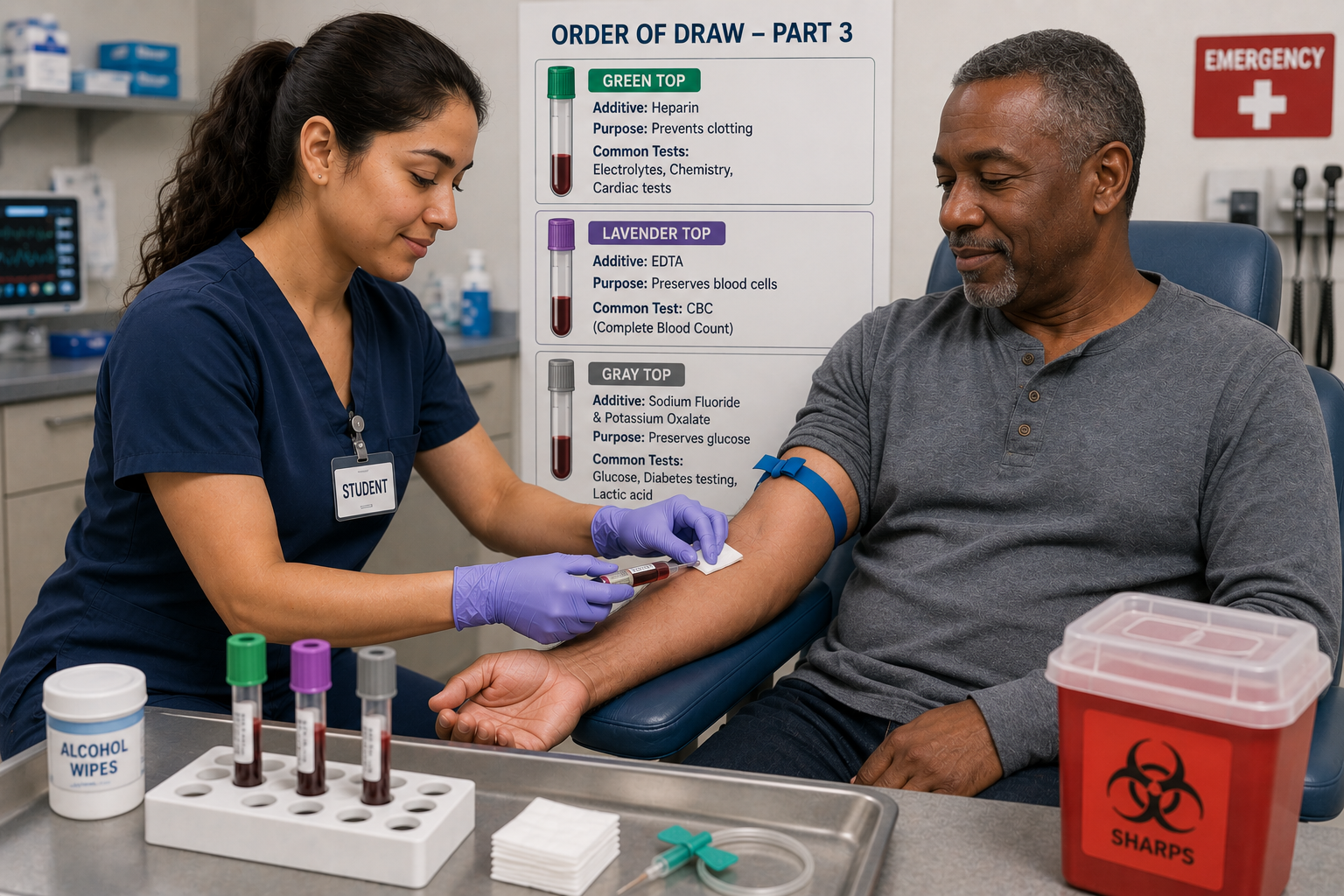
Characters
Kayla — phlebotomy student
Mr. Jordan — patient in the emergency department
Kayla:
Good evening. My name is Kayla, and I’ll be drawing your blood today.
Mr. Jordan:
Busy night?
Kayla:
Very busy.
Mr. Jordan:
Emergency room?
Kayla:
Yep. Lots of bloodwork tonight.
(Kayla prepares the supplies.)
Mr. Jordan:
You still studying those tube colors?
Kayla:
Always.
Mr. Jordan:
What colors are left?
Kayla:
Tonight:
green,
lavender,
and gray.
Mr. Jordan:
What’s special about the green tube?
Kayla:
The green tube contains an additive called heparin.
Mr. Jordan:
What does heparin do?
Kayla:
It prevents blood from clotting.
Mr. Jordan:
Didn’t another tube already do that?
Kayla:
Yes, but different additives work in different ways and are used for different tests.
Mr. Jordan:
So why use heparin?
Kayla:
Heparin helps produce plasma quickly, which is useful in emergency situations when doctors need fast laboratory results.
Mr. Jordan:
What kinds of tests use green tubes?
Kayla:
Commonly:
electrolyte tests,
chemistry panels,
and cardiac testing.
Mr. Jordan:
Electrolytes like sodium and potassium?
Kayla:
Exactly.
Mr. Jordan:
Those affect the heart, right?
Kayla:
Yes. Electrolytes help control:
muscles,
nerves,
hydration,
and heart rhythm.
(Kayla places the tourniquet.)
Kayla:
This will feel tight for a moment.
Mr. Jordan:
No problem.
(Kayla palpates the vein.)
Mr. Jordan:
You seem much more confident now.
Kayla:
Understanding the purpose behind the tubes helps a lot.
Mr. Jordan:
Probably easier than memorizing random colors.
Kayla:
Definitely.
(Kayla cleans the site.)
Kayla:
Cold alcohol wipe.
Mr. Jordan:
Always cold.
(Kayla performs the venipuncture.)
Kayla:
Small pinch.
(Blood begins flowing into the green tube.)
Mr. Jordan:
So what comes after green?
Kayla:
The lavender tube.
(Kayla changes tubes.)
Mr. Jordan:
What’s inside the lavender one?
Kayla:
An additive called EDTA.
Mr. Jordan:
What does EDTA do?
Kayla:
It preserves blood cells and prevents clotting.
Mr. Jordan:
Why preserve the blood cells?
Kayla:
Because some laboratory tests need to examine the blood cells themselves while they’re still intact.
Mr. Jordan:
What tests?
Kayla:
A very common one is called a CBC.
Mr. Jordan:
What does CBC mean?
Kayla:
Complete Blood Count.
Mr. Jordan:
And what does that test measure?
Kayla:
It measures:
red blood cells,
white blood cells,
hemoglobin,
hematocrit,
and platelets.
Mr. Jordan:
That sounds like a lot from one tube.
Kayla:
Blood contains a huge amount of information.
Mr. Jordan:
What do those blood cells actually do?
Kayla:
Red blood cells carry oxygen through the body.
White blood cells help fight infection.
Platelets help blood clot after injuries.
Mr. Jordan:
So CBCs help doctors look for problems?
Kayla:
Exactly. CBC results can help show:
infection,
anemia,
inflammation,
bleeding disorders,
and many other conditions.
(Kayla gently inverts the lavender tube.)
Mr. Jordan:
And you still have to mix the additive carefully?
Kayla:
Right. Proper mixing helps preserve accurate results.
Mr. Jordan:
So what’s the last tube?
Kayla:
The gray tube.
(Kayla changes tubes again.)
Mr. Jordan:
What’s inside the gray tube?
Kayla:
Usually sodium fluoride and potassium oxalate.
Mr. Jordan:
That sounds less friendly.
Kayla:
Definitely less friendly sounding.
(Both laugh.)
Mr. Jordan:
What do those additives do?
Kayla:
They help preserve glucose levels in the blood sample.
Mr. Jordan:
Why is that important?
Kayla:
Because blood cells naturally continue using glucose after collection. If the glucose changes too much before testing, the laboratory result may become inaccurate.
Mr. Jordan:
So the tube basically helps “freeze” the glucose level?
Kayla:
That’s actually a pretty good way to think about it.
Mr. Jordan:
What tests use gray tubes?
Kayla:
Commonly:
glucose testing,
diabetes testing,
glucose tolerance tests,
and lactic acid testing.
Mr. Jordan:
There’s way more science behind blood draws than I realized.
Kayla:
That’s something patients say almost every day.
(Kayla fills the final tube.)
Kayla:
Alright, I’m releasing the tourniquet now.
(She removes the needle and places gauze on the site.)
Kayla:
Please hold pressure here.
Mr. Jordan:
Got it.
(Kayla activates the safety device and disposes of the needle safely.)
Mr. Jordan:
So now you’ve learned all the major order-of-draw tubes?
Kayla:
The major ones, yes.
Mr. Jordan:
And you finally survived all the colors?
Kayla:
Barely.
Mr. Jordan:
Which tube was hardest to learn?
Kayla:
Honestly? The tubes became easier once I understood what the blood was actually being used for.
Mr. Jordan:
That makes sense.
Kayla:
Memorizing colors is hard.
Understanding patients is easier.
(Mr. Jordan smiles.)
Mr. Jordan:
That sounds like the beginning of becoming a good healthcare worker.
(Kayla smiles back.)
Kayla:
I hope so.