Phlebotomy - Order of Draw Stories — Part 2 - “The Serum Tubes”
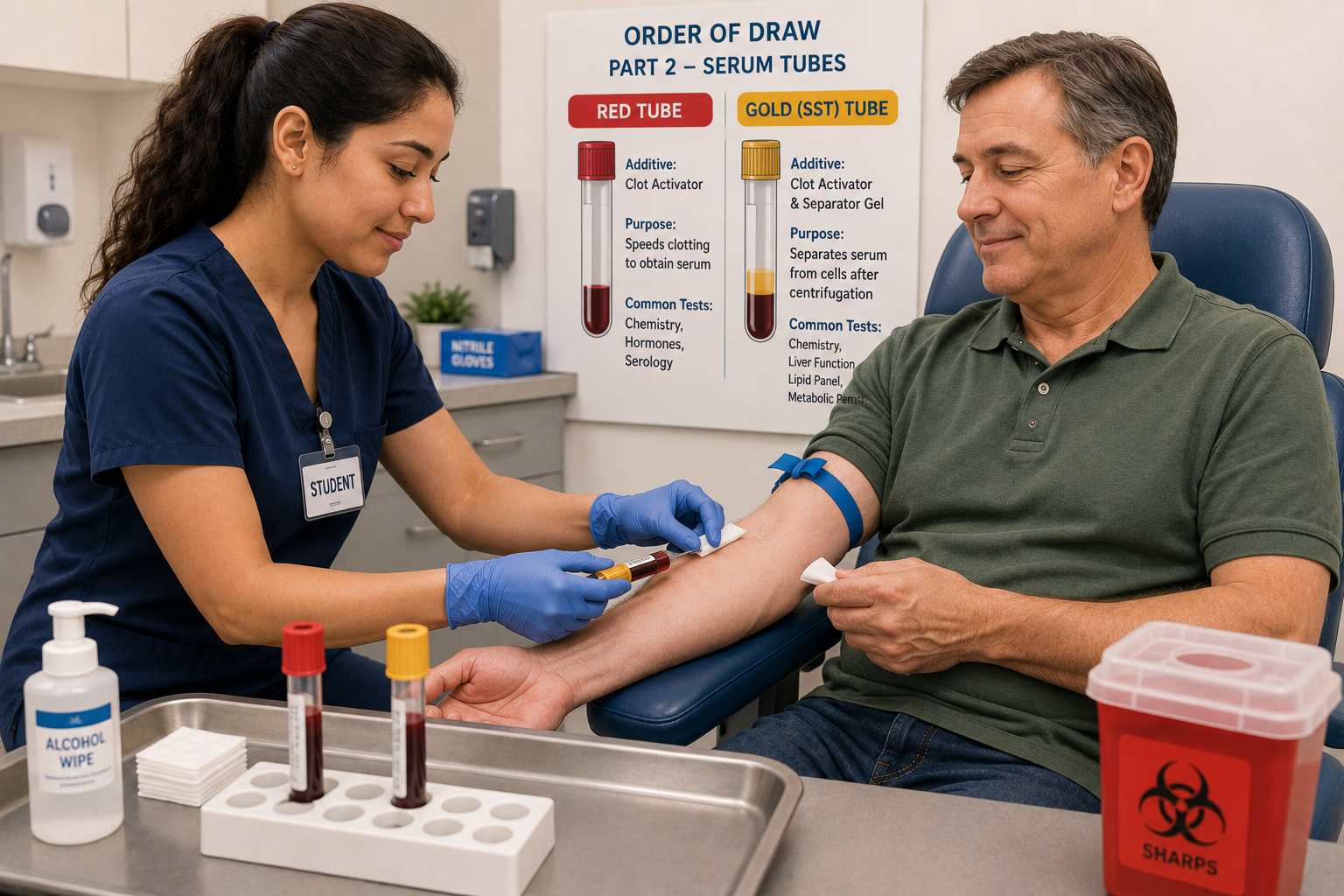
Characters
Kayla — phlebotomy student
Mr. Bennett — patient getting routine bloodwork
Kayla:
Good afternoon. My name is Kayla, and I’ll be drawing your blood today.
Mr. Bennett:
Afternoon. You look familiar.
Kayla:
You might have seen me here last week. I’m still training in phlebotomy.
Mr. Bennett:
Still learning all the tube colors?
Kayla:
Unfortunately… yes.
Mr. Bennett:
How many are there?
Kayla:
Too many.
(Both laugh.)
(Kayla prepares the supplies.)
Mr. Bennett:
So what are you studying today?
Kayla:
Today we’re focusing on the red tube and the gold tube, also called the SST tube.
Mr. Bennett:
What does SST mean?
Kayla:
Serum Separator Tube.
Mr. Bennett:
What exactly is serum?
Kayla:
Serum is the liquid part of blood after the blood has clotted.
Mr. Bennett:
So blood changes after it clots?
Kayla:
Yes. Blood contains:
red blood cells,
white blood cells,
platelets,
and liquid called plasma.
But when blood clots, some clotting proteins are removed, and the remaining liquid is called serum.
Mr. Bennett:
Why do laboratories want serum instead of whole blood?
Kayla:
Many chemistry tests work best using serum because it gives clearer laboratory results.
Mr. Bennett:
What kinds of chemistry tests?
Kayla:
Things like:
cholesterol,
liver function tests,
kidney function,
hormones,
electrolytes,
and metabolic panels.
Mr. Bennett:
So these tubes are used a lot?
Kayla:
Very often. Routine checkups commonly use serum tubes.
(Kayla places the tourniquet.)
Kayla:
This will feel a little tight.
Mr. Bennett:
No problem.
Kayla:
Can you make a fist for me?
(Mr. Bennett makes a fist.)
(Kayla palpates the vein.)
Mr. Bennett:
You seem more confident than last time.
Kayla:
I’m trying to understand the science instead of only memorizing colors.
Mr. Bennett:
That probably helps.
Kayla:
It does. When I understand why a tube is used, the order makes more sense.
(Kayla cleans the site.)
Kayla:
This alcohol will feel cold.
Mr. Bennett:
Always cold.
(Kayla performs the venipuncture.)
Kayla:
Small pinch.
(Blood begins flowing into the red tube.)
Mr. Bennett:
So what’s inside the red tube?
Kayla:
Some red tubes contain no additive at all. Others contain something called a clot activator.
Mr. Bennett:
What does a clot activator do?
Kayla:
It helps the blood clot faster.
Mr. Bennett:
Wait… earlier you said the light blue tube prevents clotting.
Kayla:
Exactly.
Mr. Bennett:
And now this tube helps blood clot?
Kayla:
Right. Different tests require blood in different conditions.
Mr. Bennett:
Healthcare really is chemistry.
Kayla:
And biology. And communication. And sometimes controlled panic.
(Mr. Bennett laughs.)
(Kayla switches to the gold SST tube.)
Mr. Bennett:
What’s different about the gold tube?
Kayla:
The SST tube contains:
a clot activator,
and a special separator gel.
Mr. Bennett:
Separator gel?
Kayla:
After the blood clots, the tube is spun in a centrifuge.
Mr. Bennett:
A centrifuge… that spinning machine?
Kayla:
Exactly. The spinning separates the blood components.
Mr. Bennett:
And the gel helps separate them?
Kayla:
Yes. The gel forms a barrier between the serum and the blood cells.
Mr. Bennett:
Why is that useful?
Kayla:
Because laboratories often need clean serum without blood cells mixing into it later.
Mr. Bennett:
So the gel keeps everything separated after spinning?
Kayla:
Exactly.
(Kayla gently inverts the SST tube.)
Mr. Bennett:
You’re flipping the tube again.
Kayla:
Right. The additives must mix properly with the blood.
Mr. Bennett:
But not too hard?
Kayla:
Correct. Shaking can damage blood cells and affect results.
Mr. Bennett:
I honestly never realized how much thought goes into a simple blood draw.
Kayla:
A lot of mistakes in laboratory medicine can happen before the sample even reaches the lab.
Mr. Bennett:
So phlebotomy affects the whole testing process.
Kayla:
Very much.
(Kayla finishes the final tube.)
Kayla:
Alright, I’m releasing the tourniquet.
(She removes the needle and places gauze on the arm.)
Kayla:
Please hold pressure here.
Mr. Bennett:
Got it.
(Kayla activates the safety device and disposes of the needle.)
Mr. Bennett:
So today’s lesson was:
serum,
clot activators,
separator gel,
and SST tubes?
Kayla:
Exactly.
Mr. Bennett:
And next comes more colors?
Kayla:
Green, lavender, and gray.
Mr. Bennett:
Sounds complicated.
Kayla:
It is. But it’s starting to make sense now.
Mr. Bennett:
That’s probably when real learning begins.
(Kayla smiles.)
Kayla:
I think you’re right.