Phlebotomy Story - A Busy Morning in the Laboratory
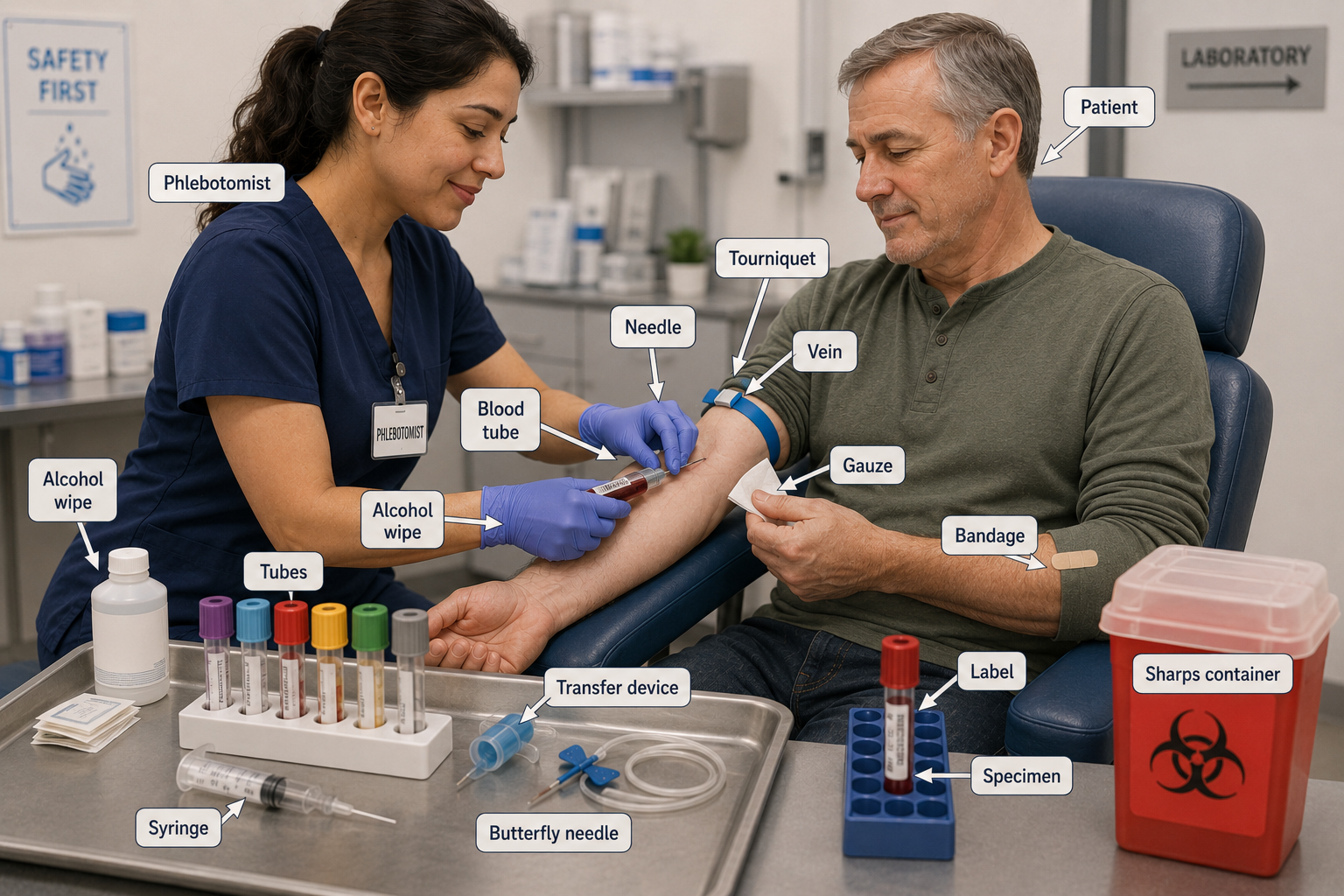
Characters
Elena — a phlebotomist
Mr. Harris — a patient
Elena:
Good morning. My name is Elena, and I’m the phlebotomist who will be drawing your blood today.
Mr. Harris:
Morning. I’ve had blood tests before, but I still don’t enjoy them.
Elena:
Most people don’t. I’ll explain everything as we go.
Mr. Harris:
I appreciate that.
(Elena washes her hands and puts on PPE.)
Mr. Harris:
What does PPE mean?
Elena:
It means Personal Protective Equipment. These gloves help protect both the patient and the healthcare worker from infection.
Mr. Harris:
Makes sense.
(Elena prepares the supplies on the tray.)
Mr. Harris:
There are a lot of tools there.
Elena:
Yes. I need several blood collection tubes, an alcohol wipe, gauze, labels, and a needle holder.
Mr. Harris:
What are all the different colored tubes for?
Elena:
Different tests require different tubes. That’s why we follow the correct order of draw.
Mr. Harris:
Order of draw?
Elena:
The tubes must be filled in a specific order to prevent contamination between additives inside the tubes.
Mr. Harris:
Wow. I didn’t realize there was so much procedure involved.
(Elena picks up a tube and examines it carefully.)
Mr. Harris:
Checking for something?
Elena:
Yes. I’m checking for any defect in the tube. If a tube is cracked or damaged, I must discard it.
Mr. Harris:
Better safe than sorry.
Elena:
Exactly.
(Elena places the tourniquet around Mr. Harris’s arm.)
Elena:
This will feel a little tight.
Mr. Harris:
That’s okay.
Elena:
Can you make a fist for me?
(Mr. Harris makes a fist.)
Elena:
Good. I’m looking for a prominent vein.
Mr. Harris:
What does that mean?
Elena:
A prominent vein is one that’s easy to see and feel.
(She gently touches the arm.)
Elena:
I think I found a good one.
(Elena cleans the arm.)
Mr. Harris:
That’s cold.
Elena:
This alcohol wipe contains antiseptic to clean the skin and kill germs before the needle enters the vein.
Mr. Harris:
So infection doesn’t happen?
Elena:
Exactly.
(Elena prepares the needle.)
Mr. Harris:
I try not to look at needles.
Elena:
A lot of people say that.
Mr. Harris:
I’m one of those people.
Elena:
Don’t worry. Small pinch.
(She performs venipuncture.)
Mr. Harris:
Actually… that wasn’t too bad.
Elena:
Good. The blood is flowing into the blood collection tube now.
(Elena fills the first tube.)
Mr. Harris:
Why are you turning the tube upside down?
Elena:
That’s called inverting the tube. Some tubes contain additives that need to mix gently with the blood.
Mr. Harris:
So you don’t shake them?
Elena:
No. Shaking can damage the blood cells.
(Elena prepares another tube.)
Mr. Harris:
Do you always use tubes like this?
Elena:
Usually. But sometimes we use a syringe instead.
Mr. Harris:
When would you do that?
Elena:
Sometimes patients have small or fragile veins, so a syringe gives more control.
Mr. Harris:
And then what happens to the blood?
Elena:
We use a transfer device to move the blood safely from the syringe into the tubes.
Mr. Harris:
Do children get blood tests differently?
Elena:
Sometimes. Pediatric patients often have very small veins.
Mr. Harris:
Do you use smaller needles?
Elena:
Yes. We often use a butterfly needle set for children or difficult veins.
Mr. Harris:
Butterfly needle sounds less scary than regular needle.
Elena:
That may be why people like the name.
Mr. Harris:
What about older people?
Elena:
Geriatric patients can also have delicate veins, so we have to be extra careful.
Mr. Harris:
My mother always bruises after blood draws.
Elena:
That happens sometimes because elderly veins can be fragile.
(Elena adjusts the equipment.)
Mr. Harris:
What’s that plastic part connected to the needle?
Elena:
That part is called the hub. It connects the needle to the holder.
(Elena fills the final tube.)
Elena:
Alright, I’m releasing the tourniquet now.
(She removes the needle.)
Elena:
Please hold this gauze on your arm.
Mr. Harris:
Like this?
Elena:
Perfect.
(She activates the needle safety device.)
Mr. Harris:
Where does the needle go now?
Elena:
Into the sharps container. Used needles must always be discarded safely.
(She places the needle into the sharps container.)
(Elena places a bandage on the arm.)
Elena:
There you go.
Mr. Harris:
That was easier than I expected.
Elena:
I’m glad to hear that.
(Elena places a label on each tube.)
Mr. Harris:
Why do you label them immediately?
Elena:
To make sure the correct specimen is matched to the correct patient.
Mr. Harris:
That sounds important.
Elena:
Very important. After labeling, the blood specimen goes to the laboratory for testing.
Mr. Harris:
You know, I never realized how much training goes into this job.
Elena:
There’s a lot more to phlebotomy than people think.
Mr. Harris:
Well, you made it look easy.
Elena:
That usually means things went well.
Mr. Harris:
Thank you for explaining everything.
Elena:
You’re welcome. Have a great day.
Mr. Harris:
You too. And good luck with the rest of your patients today.